Collaborations
Collaborations with artists of various disciplines:
- Music
- Dance
- Theater
- Film and Video
- Visual Artists
- Taiko Groups
Artist and Performer Bios of Featured Artists
Abhijit Banerjee (tabla)
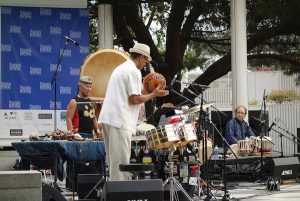
Rhythm Central: Taiko, Tabla, and Timbales” Project
Abhijit Banerjee is considered among the front ranking tabla players from India, one of the most-sought after artists in the realm of Indian classical music. He is renowned for his unique style and creative approach, for his sensitivity, skill and deep sense of musicality. In addition to his contributions to Indian music he has left his mark in a diverse field of crossover music both as a performer and composer. Abhijit and Endo met through UCLA’s APPEX project and have been performing together in the United States and India.
Abhijit and Kenny join together with John Santos for the Rhythm Central project: Taiko, Tabla, and Timbales in 2011-2012.
John Santos (congas, timbales, Latin percussion)
Rhythm Central: Taiko, Tabla, and Timbales” Project
Five-time Grammy nominee, and US Artists Fellow, John Santos is one of the foremost exponents of Afro-Latin music in the world today. He is known for his innovative use of traditional forms and instruments in combination with contemporary music, as well as for his groundbreaking work in bringing together styles, rhythms, concepts and artists from different generations. With over 35 years of performing and teaching, he has earned much respect and recognition as an educator, composer, and record and event producer.
John joins Kenny Endo and Abhijit Banerjee for the Rhythm Central project: Taiko, Tabla, and Timbales in 2011-2012.
Hitoshi Hamada 浜田均 (Vibraphones)

GATEWAY Touring Ensemble 2010
Hitoshi Hamada is considered the top jazz vibraphonist in Japan today. Born in Hokkaido, Hamada began playing mallet instruments at the age of six. He took a liking to jazz in high school and used the marimba to practice with. After graduating from Tokyo University of the Arts, he made his professional debut with the group “Force.” Hamada is also an accomplished composer, arranger, pianist, percussionist, and leader of his own ensemble. He has appeared on numerous recordings and has published several albums as a bandleader.
Hamada’s virtuoso technique and joyful, spirited performance enriches Endo’s music adding a fun new dimension to the ensemble. Hamada can be heard on Endo’s CD “Jugoya.”
Shoko Hikage 日影昌子 (Koto)
GATEWAY Touring Ensemble
Shoko Hikage began playing koto at the age of three with the Ikuta-ryu Sokyoku Seigen Kai in Akita prefecture, Japan. She graduated from Takasaki College with a major in koto music and subsequently received her master’s certificate from Tadao and Kazue Sawai.
Hikage performs regularly in solo situations and in collaboration with a wide range of artists from every genre. She currently resides in San Francisco where she continues her pursuits in improvisational dance and music.
Jeff Peterson (Hawaiian Slack Key Guitar)
Recognized as one of Hawaii’s most versatile musicians, Jeff Peterson is at the heart of the Hawaiian music scene today. His passion for the guitar has allowed him to shine as a solo artist and has given him the opportunity to collaborate with a wide variety of artists from Hawaii, across the US, and abroad. His focus on Slack Key guitar, classical, and jazz music has allowed him to develop a unique and transcendent voice on the guitar while being deeply rooted in the traditions of his Hawaiian heritage. He has contributed to two Grammy Award-winning recordings and has been honored with three Na Hōkū Hanohano Awards in Hawaii.
His latest solo CD Maui on My Mind was recognized as the Slack Key Album of the Year in 2010. His latest release features his songwriting, performing, and producing on Amy Hanaiali`i and Slack Key Masters of Hawaii. The groundbreaking recording features a collaboration between Jeff, Amy Hanaiali`i, Cyril Pahinui, Dennis Kamakahi, Sonny Lim, and Chino Montero.
Five of Jeff’s songs including Hawaiian Skies were featured in the film The Descendants starring George Clooney.
Riley Lee (shakuhachi, taiko)
Riley Lee began playing the shakuhachi in 1971. He is the recipient of two of the oldest and most venerated lineages of traditional shakuhachi, which can be traced back to the Zen Buddhist komusô, or “priests of nothingness” of the Edo period in Japan. In 1980, he became the first non-Japanese to attain the rank of dai shihan or Grand Master.
In 1973, Riley became the first non-Japanese to play taiko professioanlly, by touring internationally as a full-time performer of taiko (Japanese festival drums), yokobue (a high pitched bamboo transverse flute) and shakuhachi with Ondekoza (now called Kodo) a troupe of traditional Japanese musicians, performing with such groups as the Boston Symphony Orchestra, and at venues such as Kennedy Center (Washington DC), Roundhouse Theatre (London), Espace Pierre Cardin (Paris), and the Boston Symphony Hall.
He has been instrumental in creating a professional presence of traditional Japanese music in Australia. He helped found the Australian Shakuhachi Society in 1996. In 1995, he co-founded with Ian Cleworth, Australia’s dynamic Japanese festival drum group, TaikOz. It has since become one of Australia’s premier performance groups, acclaimed both at home and in Japan.
Riley has made over fifty commercially released recordings since 1980, which are sold worldwide on a number of labels.
Kiyohiko Semba (Japanese and Western percussion)
The son of Koyu Semba, head master of the Semba School of Japanese traditional music, Kiyohiko Semba took up traditional drums and percussion under his father at the age of three. He made his debut on the Kabuki stage at the age of 10 and has been pursuing his career as a musician ever since.
As a distinguished percussionist, of deep musical capacity, Semba has developed his many and diverse activities not only on the Japanese traditional music scene but also in pop music and various traditional music genres.
Most recently, in 1999, Semba released his third solo album, Semba, a Kozuchi (mallet) of Rhythm in which he exhibited his talents on 80 different percussion instruments. In the same ear, he formed his new group, “Unit Semba” with the talented bassists, Nobou Nakahara and Benisuke Sakai, which later became “Semba Sonic Spear,” and released the group’s first album Sonic Spear in 2003.
Kaori Takahashi (electric violin)
Kaori Takahashi began playing violin at the age of four with lessons from her father. After graduating from Toho Gakuen University, she received the Tasaki Pearl Corporation Scholarship to study at the International Menuhin Music Academy in Switzerland.
In 1987, Ms. Takahashi was accepted to the Art Academy of Berlin where she graduated in 1991. She moved to Dusseldorf where she was active in contemporary music. Since returning to Tokyo in 1992, she has been performing and recording classical, jazz and popular music.
Kaoru Watanabe (flute/fue, taiko)
Born in July 3rd, 1975 to St. Louis Symphony musician parents. Started playing classical flute and taiko (Japanese drum) in early middle school. Graduated from Interlochen Arts Academy in Michigan before moving to New York to study Jazz Performance at the Manhattan School of Music. Performed and recorded with Stefon Harris and Jason Moran on Blue Note Records, among others.
Moved to Japan after graduation in order to learn Japanese, to try toget to know his Grandparents and other relatives better and to study Japanese music. In Tokyo studied Noh Kan (flute used in Noh and Kabuki theater) with Hiroyuki Matsuda, and the fue (bamboo flute) music of Edo Matsuri Bayashi with Kiyosuke Kobayashi. Moved to Sado Island in 1998 to become an apprentice with the drumming ensemble Kodo. As an apprentice, spent the next two years learning taiko, various traditional folk dances, singing, tea ceremony, Noh, and Kyogen, growing rice and other vegetables, and waking up before sunrise to run 6 miles every morning.
After finishing the apprenticeship, became a performing member of Kodo, drumming, dancing and singing, but primarily as a fue player. Was able to travel the world with Kodo, performed original compositions on stage at Carnegie Hall with Mom in the audience. In 2005 became Artistic Director of Earth Celebration, Kodo’s annual world music festival held in Sado every summer. Left Kodo in September of 2006 and has moved back to New York City to continue making music on the fue and flute in a variety of settings as well as teaching fue and taiko. Still works closely with Kodo and will continue to hold the position of Artistic Director for Earth Celebration. Spends a good deal of time in both the US and Japan, continuing his studies and performing.
Japanese Interview with Kaoru Watanabe: http://www.miyamoto-unosuke.co.jp/taiko/artist/
Rhythm Summit Trio (Endo, Okimoto, and Taba)
This trio was born from a unique collaboration made possible by the Honolulu Mayor’s Office of Culture and the Arts in 2008, bringing together the artistry and musicality of world class artists, Kenny Endo (taiko, bamboo flute, percussion), Noel Okimoto (drums, vibraphones, percussion), and special guest Dean Taba (acoustic and electric bass) for an extraordinary East-West collaboration. Endo is the vanguard of contemporary taiko and has created novel compositions from his background in western, eastern, and world music and through his belief that tradition is the basis for innovation. Okimoto is a Royal Hawaiian Band member, composer, vibist, and considered the #1 jazz drummer in Hawaii. Together with cutting edge guest artist Dean Taba on bass, they have created compelling music, blending rhythms and sounds from east and west. Watch for their CD release in 2010.
Noel Okimoto (drumset, vibraphones, marimba, percussion)
Born and raised in Hononlulu, Noel Okimoto has been playing professionally since the age of ten, and is now considered one of the best drummers in Hawaii. He got his Bachelor’s Degree in Percussion at the University of Hawaii. Noel has played in Hawaii, the Mainland, and internationally with Freddie Hubbard, the Woody Herman Orchestra, Stan Getz, Bobby Hutcherson, among others. He was also a member of the Gabe Baltazar group for five years.
Okimoto is also a very accomplished orchestral percussionist, vibist, composer and clinician. He has played percussion with many luminaries, including Henry Mancini, Nelson Riddle, Steve Allenn, Natallie Cole, Bob Hope, Rosemary Clooney, Patti Page, and Dionne Warwick.
Dean Taba (bass, percussion)
Now a highly regarded studio and freelance musician, Dean Taba began his musical studies on the piano at the age of six and played french horn in the Hawaii Youth Symphony. It was a desire to play in the high school jazz band that introduced him to the bass and improvised music. After extensive studies at the Berklee College of Music in Boston and a refinement of his skills on both the acoustic and electric bass, Dean relocated in 1984 to Los Angeles to become one of its most in-demand musicians.
Also a respected clinician and educator (Los Angeles Music Academy, Musician’s Institute, Cal-Poly Pomona, Grove School of Music), Dean has recently performed/recorded with David Benoit, Mark Murphy, Jake Shimabukuro, Hiroshima, and many others as well as playing on countless CDs, TV shows, and movie sound tracks.
In spite of his busy schedule, Dean is always sure to devote time to writing music for his own projects; the latest of his three CDs is The Camarillo Waltz. This recording features 10 of Dean’s innovative jazz compositions. Dean emphasizes, “I am grateful for every opportunity to make and share music.”
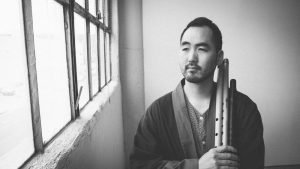
Christopher Yohmei Blasdel (shakuhachi)
Christopher Yohmei Blasdel began the shakuhachi in 1972 under Living National Treasure shakuhachi master Goro Yamaguchi. Graduated (MFA) in ethnomusicology, Tokyo University of Fine Arts, 1982. Blasdel specializes in traditional and contemporary Japanese music and free improvisation. Blasdel performs around the world and has taught or lectured at such prestigious institutions as Earlham College (Indiana), Chulalongkorn University (Bangkok), Texas A&M University, University of Washington, Charles University (Prague) and many others. Discography includes Navarasa (2010), Breath Play (2007), Visionary Tones (2005) and Zen Reveries (1996). Christopher was co-organizer of the Boulder World Shakuhachi Festival ’98, the Sydney World Shakuhachi Festival in 2008 and the yearly Prague Shakuhachi Festival. His publications include “The Single Tone―A Personal Journey through Shakuhachi Music” and “The Shakuhachi–A Manual for Learning,” the foremost instruction manual for shakuhachi in English. Christopher presently teaches Japanese music at Temple University in Tokyo and is Artistic Director of the International House of Japan. He has practiced Aikido for over 35 years and holds a third-degree black belt.
Blasdel co-organized the World Shakuhachi Festival ’98 held in Boulder, Colorado and was a member of the executive committee for the World Shakuhachi Festival, Sydney, 2008. He is senior advisor to the yearly Prague International Shakuhachi Festival. Presently, he teaches Japanese music at Temple University in Tokyo and is the Artistic Director of the International House of Japan. Blasdel was also a member of the Japanese performing group, Aura-J, specializing in contemporary music for traditional instruments.
Mika Kimula (vocals)
MIKA KIMULA (vocalist)
Interested in voice, theater and language, Mika Kimula began her vocal studies at Tokyo Geidai (National University of Fine Arts and Music). At Geidai she also studied the Noguchi Taisô body awareness method (including the technique of how language is respondent to the voice and one’s inner image) with the late Michizô Noguchi and life morphology (how life responds to the voice) with the late Dr. Shigeo Miki.
She was an artist in residence at Earlham College in 1988, and in 1997, she taught Japanese language and voice for a year at Chatham College (Pittsburgh) as a Fulbright Scholar.
Presently, Kimula performs, records, teaches, writes, translates and gives workshops throughout Japan, the United States and around the world. She currently teaches both privately and publically at Ferris University in Yokohama and privately. She is also featured on numerous recordings.
Madi Sato (vocals)
MADI SATO (vocalist)
Madi Sato is a Japanese/American singer and songwriter, sound healer, poet, actress, and teacher. She has performed and recorded music ranging from blues and jazz to sacred world music. In early 2011, Kenny joined Madi along with David Wheeler (shakuhachi), Koji Nakamura (taiko), Yukiko Matsuyama (koto), Timothy McLaughlin (poetry), and John Rangel (pianist) at the Zen Center in Crestone, Colorado to record “Return to the River” aka “Songs for Sendai.”